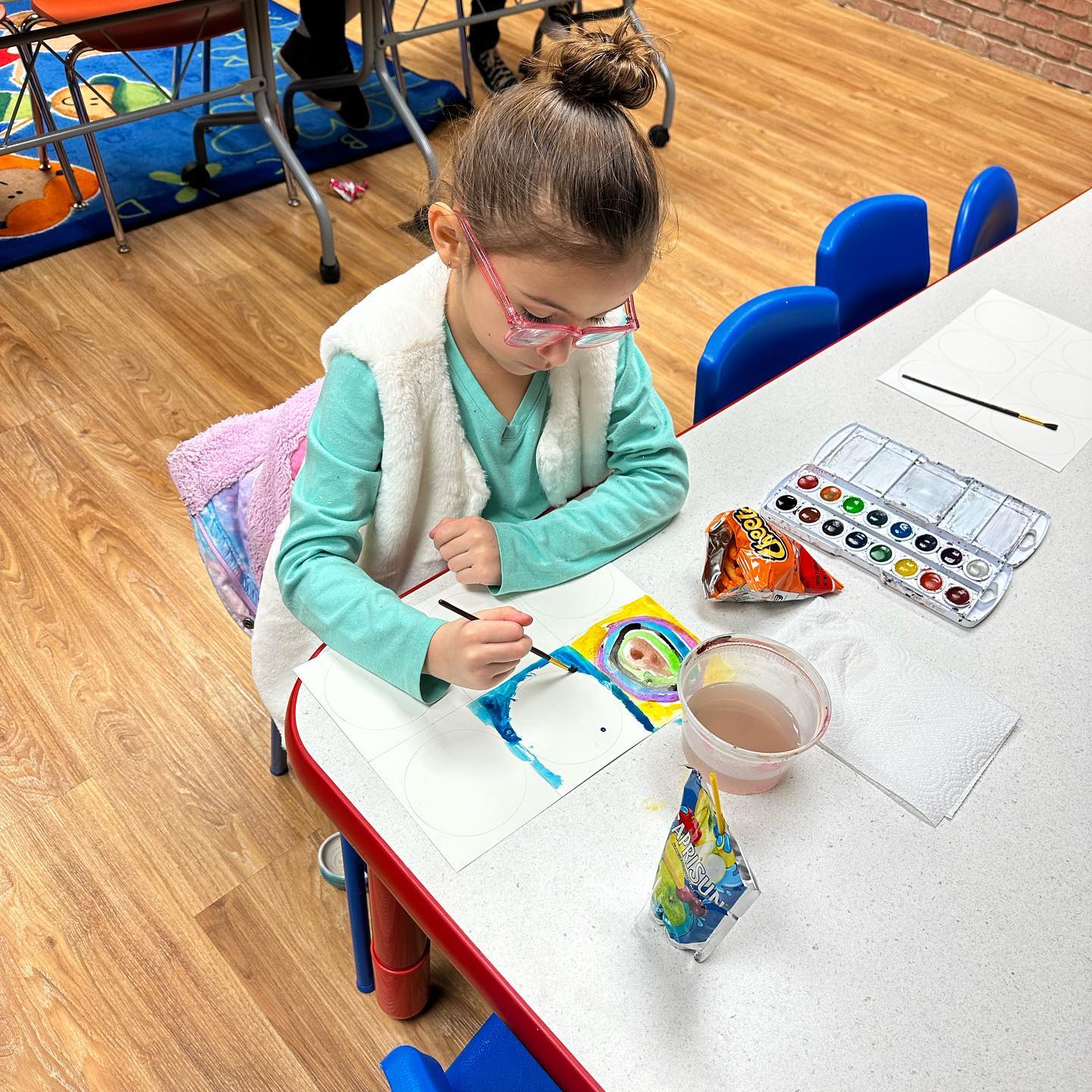
Dan Flavin, Andy Warhol, Michelangelo, and now Wassily Kandinsky. Art Club quickly became one of the most exciting and flexible programs I offered at the library. Each session began with learning about an artist or art style, followed by a hands-on project inspired by their work.
This program, open to grades 1–12, means every project had to be simple enough for younger kids while still feeling meaningful for teens. With unpredictable attendance (as you’re familiar), flexibility was always key—and this project delivered beautifully.
This Art Club session focused on Wassily Kandinsky. A pioneer of abstract art who believed that colors and shapes could express feelings—just like music.
🎨 Introducing Kandinsky
We started with a short, engaging presentation featuring Kandinsky’s work, especially his famous Several Circles and concentric circle studies.
Here’s a simple, kid-friendly introduction you can use:
Wassily Kandinsky was an artist who believed that art didn’t have to look like real things. Instead, he used colors, shapes, and lines to express emotions. He also believed that music and art were connected, and that different sounds could inspire different colors.
The idea that you could hear a sound and turn it into color immediately clicked with the kids.
And just like that—we got to work.
The Inspiration: Painting What You Hear
Kandinsky experienced something called synesthesia, which meant he could connect sounds with colors and shapes.
So instead of copying an image, we painted what we heard.
The Project: Concentric Circles with Sound-Inspired Color
This project combined art, music, and a little bit of experimentation.
Step 1: Create a Color Chart
Before painting, we created a simple color guide together.
Using different instruments, we asked:
- What color does this sound feel like?
- Is it bright or dark?
- Loud or soft?
We used instruments like:
- Bells
- Shaker eggs
- Drum
- Ukulele
Each sound was assigned a color based on the group’s interpretation.
There were no wrong answers—which made this part especially fun.
Step 2: Draw the Circles

Each child received watercolor paper and drew a grid of large circles (or traced circular objects if needed).
Inside each circle, they drew smaller and smaller rings—creating that signature Kandinsky-style concentric circle look.
Step 3: Paint What You Hear
Now the fun part.
As we played different instruments, kids:
- Listened carefully
- Chose the color that matched the sound
- Painted one ring of their circle
Each new sound = a new color choice.
The result?
A completely unique piece of art for every child—guided by sound.
The Gallery Moment
Once the paintings dried, we displayed them together.
The variety was incredible.
Some were bold and bright.
Some were soft and muted.
Some followed patterns, others were completely unexpected.
But all of them felt intentional—and deeply personal.

Why This Program Worked
This project was successful because it combined:
- Art and music
- Creative freedom (no wrong answers!)
- Simple shapes with strong visual impact
- A connection to real art history
Younger kids loved choosing colors based on sound.
Older kids really leaned into the concept of abstract expression and interpretation.
And everyone left feeling like they had created something uniquely their own.
Supply List
- Watercolor paper
- Watercolor paints
- Paintbrushes
- Cups of water
- Paper towels
- Pencils
- Circular objects for tracing (optional)
- Simple musical instruments (whatever you have on hand!):
- Bells
- Shaker eggs
- Drum
- Ukulele (or any available instrument)
- Printed images of Kandinsky’s work
- Slideshow or short video (Example)
Tips for Success
- Keep the introduction short—kids are eager to start creating
- Emphasize that there are no wrong color choices
- Use a variety of sounds (fast, slow, loud, soft)
- Encourage kids to listen before painting
- Have extra paper ready—some will want to do more than one (or make mistakes)
Final Thoughts
Kandinsky believed that art could be felt, not just seen—and this project brought that idea to life in such a fun, accessible way.
Art Club is at its best when kids are free to explore, experiment, and express themselves.
And this time, they didn’t just make art.
They heard it. 🎶
If you enjoyed this post and want to see others like it, check out these popular posts & subscribe to get the next one delivered to your inbox!
*This blog is intentionally ad-free. I want it to be a clean, distraction-free space. Here, public librarians can find practical ideas for youth services, outreach, and programming. There will be no pop-ups or sponsored clutter.
Some posts may include affiliate links for books or supplies I genuinely use and recommend. If you choose to purchase through those links, I may earn a small commission at no additional cost to you. It’s a simple way to support the work while getting materials for your own programs.
If you’ve found value in these ideas, please consider helping keep the blog running. Tips are always appreciated. They go directly toward hosting costs and content creation. You can do so here: https://www.paypal.com/ncp/payment/SPBXH4RPDHCCY

Leave a Reply