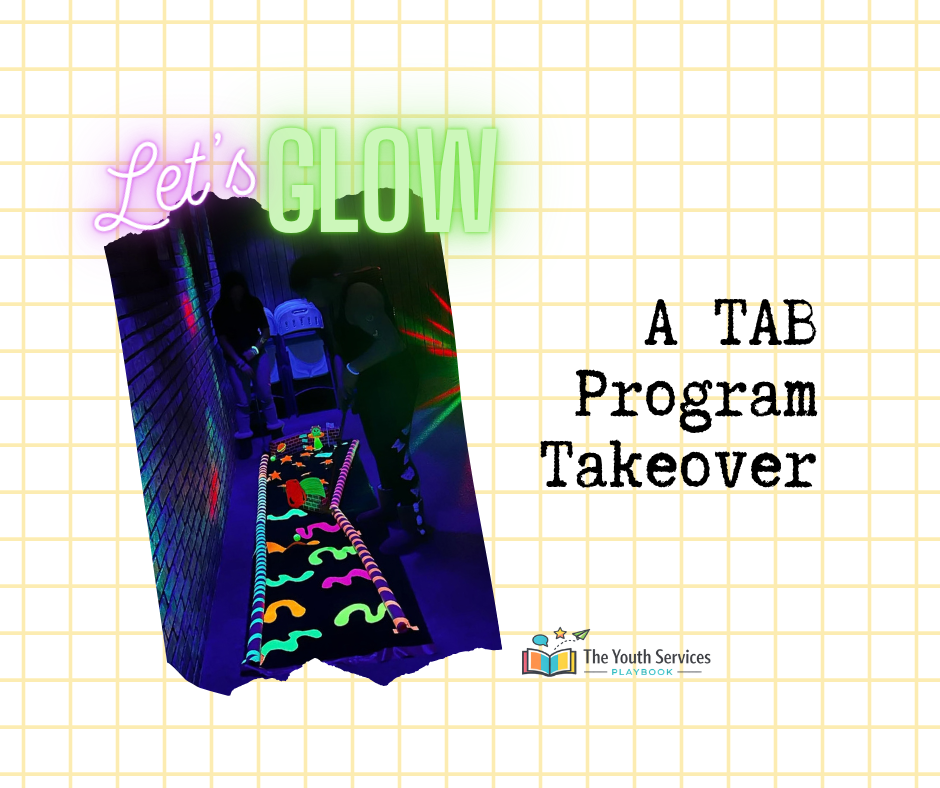
What happens when you hand your Teen Advisory Board a blank canvas, a pile of supplies, and permission to create their own library program?
Glow Mini Golf.
This wasn’t a program I created and asked the teens to help with. It was their program.
Our Teen Advisory Board (TAB) designed it, planned it, promoted it, built it, and helped run it—and watching them take ownership of the entire process was amazing!
And apparently, it wasn’t just something our library loved! Glow Golf was added to the American Library Association’s Programming Librarian website, giving other libraries the opportunity to learn from and recreate the program.
Yes, the library became a glow-in-the-dark mini golf course.
But more importantly, the teens got a real-world opportunity to work as a team, manage a project, solve problems, communicate, market an event, and see an idea go from a piece of paper to an actual program.
That’s what made this program such an incredible learning experience.
[Read: From Hanging Out to Having a Voice: Starting a Teen Advisory Board]
Start With the Idea
The basic idea was simple:
Turn the library into a glow-in-the-dark mini golf course.
We dimmed the lights throughout the library and used black light spotlights to make fluorescent materials glow. Each hole was set up in a different area of the library, and the result was part mini golf course, part black light party, and part teen-created art installation!
Let the TAB Design the Course
I divided the TAB into teams of two.
Each team was responsible for designing and building one mini golf hole.
Rather than simply giving them a list of instructions, I wanted them to think through the entire design themselves.
We started with a planning session. Each team received a piece of poster board and drew out their proposed hole.
They had to think about:
- What would the hole look like?
- Where would the ball start?
- Where would the hole be located?
- What obstacles would players encounter?
- How would the obstacles work?
- What materials would they need?
- How could they make their hole glow?
- Would it actually be possible for someone to play?
The poster board drawings became their blueprints, and there was another important purpose for this step; once they had finished their plans, each team gave me a list of the supplies they needed.
That meant the teens were not simply saying, “We need stuff.” They had to think through their design and decide which materials they actually needed to build it.
That’s project planning, and they were doing it themselves. Some needed guidance, but overall, they came up with some pretty solid designs!
Give Them a Starting Point
Each team received the same basic materials:
- One mini golf green
- One golf hole
- One pre-made obstacle
That gave everyone a foundation to work from while still leaving plenty of room for creativity.
Then the teams got creative. They built additional obstacles using things like:
- Pool noodles
- Cardboard
- Books
- Boxes
- Craft materials
They transformed ordinary materials into mini golf obstacles and then figured out how to make them glow.
Some were covered with fluorescent tape, some were painted with fluorescent paint, and others were wrapped in fluorescent paper. Under the black lights, it all glowed!
Then Make It Glow!
The glow effect was what really transformed the program.
We used black light spotlights throughout the library and incorporated fluorescent materials into the course. (Encourage your patrons to dress in neon on your advertising!)
Fluorescent Tape
Fluorescent tape was one of our easiest tools. It could be used to:
- Outline obstacles
- Mark pathways
- Create borders
- Decorate cardboard
- Highlight the edges of objects
Supply link: FLUORESCENT TAPE
Fluorescent Paint
The teens could use fluorescent paint to add designs and details to their cardboard and other materials.
Supply link: FLUORESCENT PAINT
Fluorescent Paper
Fluorescent paper was another inexpensive way to make ordinary materials pop under black light.
It worked especially well for covering cardboard obstacles and creating decorative elements.
Supply link: FLUORESCENT PAPER & FLUORESCENT CREPE PAPER
Black lights
Good black light spotlights are essential. We positioned them throughout the course so that each hole had enough light to make the fluorescent materials glow while still keeping the overall library dark.
Supply link: BLACK LIGHTS
More supplies listed below!


Don’t Forget the Marketing
The teens weren’t just responsible for building the course. They were also responsible for getting people there. They created posters to advertise the event and hung them at their schools and shared the event on their social media. This gave them another opportunity to think about what makes an event appealing.
What information does someone need?
What will make them stop and look at a poster?
How do you communicate the idea of the event quickly?
How do you get your friends interested enough to actually show up?
These are real marketing skills—and they were practicing them for a real event.
[Read: Library Social Media & Marketing Without a Marketing Team: What Actually Works]
TAB Worked the Event
On the day of the event, the teens didn’t just show up and play.
They worked it.
We created shifts so everyone had a job.
Some teens:
- Handed out putters
- Handed out golf balls
- Distributed scorecards
- Helped players navigate the course
- Applied fluorescent temporary tattoos
- Handed out glow necklaces
- Helped reset holes
- Assisted with cleanup
This was another important part of the experience. They weren’t just the kids who helped decorate. They were the staff running the program.
And Then Came the Competition
Every team wanted to know which hole was the favorite. Players were able to vote for their favorite hole after playing the course. The winning team received a prize.
That added another fun element to the event, but it also gave the teens a chance to think about their work from the participant’s perspective.
Was the hole fun?
Was it too easy?
Was it impossible?
Did it look cool?
Was the obstacle creative?
Did players actually enjoy playing it?
Sometimes the best feedback isn’t a formal evaluation. It’s watching people interact with something you’ve created!
What the Teens Learned
The mini golf course was fun.
The glow-in-the-dark library was fun.
The tattoos, glow necklaces, and competition were fun.
But underneath all of that was a pretty impressive learning experience. The teens practiced:
Project Management
They took an idea and broke it down into smaller tasks.
Teamwork
They had to work with another person to design and build a shared project.
Planning
They created blueprints and supply lists before construction began.
Budget Awareness
They had to think about what materials were actually necessary and work within the supplies available.
Problem-Solving
When something didn’t work, they had to figure out another way.
Marketing
They created promotional materials and helped spread the word.
Communication
They had to communicate with teammates, library staff, and program participants.
Event Management
They worked shifts and took responsibility for different parts of the event.
Leadership
Most importantly, they experienced what it feels like to have real ownership of a project.
Don’t Take Over
This may have been the hardest and most important part for me as the librarian.
When teens are planning a program, it’s tempting to step in. You see a problem and immediately know how to fix it. You know what materials would work. You have experience planning programs. You can see three steps ahead.
But if we want our Teen Advisory Boards to become leaders, we have to give them room to actually lead.
That means sometimes letting them try something that might not work.
Let them make decisions, solve the problems, and change their plans. Let them make a slightly wonky cardboard mini golf obstacle.
That’s okay.
The goal isn’t perfection. The goal is learning.
Making This Work at Your Library
You don’t need a huge budget or a giant library to recreate this program.
The most important part is the TAB structure.
Don’t have a Teen Advisory Board and don’t know where to start? Read: From Hanging Out to Having a Voice: Starting a Teen Advisory Board
Give each team a defined responsibility, provide a few basic materials, set a deadline, have them create a plan, require a supply list, and then let them build.
You could also challenge each team to give its hole a theme! The possibilities are endless.
Supplies
Here are some of the supplies that worked well for our course:
Mini Golf Greens: [https://amzn.to/4y7FTTw] Our greens measured 3′ x 10′. This can get pricey, but alternatively, you can design your holes in the book stacks or border them with some tape! If you plan on doing this more than once, the investment is a good one, in my opinion! Think other themed golf events!
Mini Golf Putters: [https://amzn.to/4edGDzj] Or, borrow from your local golf course!
Mini Golf Balls: [https://amzn.to/4zeynHw]
Mini Golf Holes/Cups: [https://amzn.to/47Ek0QS] Tip: crack and put a glow bracelet inside the hole!
Black Light Spotlights: [https://amzn.to/3W7IxLF]
Party Lights: [https://amzn.to/4j3yi4F] Not necessary, but really adds to the experience!
Fluorescent Tape: [https://amzn.to/4rMqV3H]
Fluorescent Paint: [https://amzn.to/4dgXbX0]
Fluorescent Paper: [https://amzn.to/4zhAevl]
Fluorescent Crepe Paper: [https://amzn.to/3Tp9Ikq]
Pool Noodles: Dollar Tree for the win
Cardboard: Save those boxes!
Glow Necklaces: [https://amzn.to/47b1WOe]
Fluorescent Temporary Tattoos: [https://amzn.to/4jeuI81]
Scorecards: [https://canva.link/clvbbj9zckdzfto] Use this free canva template!
Speaker: [https://amzn.to/4rQFaER] Not essential, but music really sets the tone and this is my favorite speaker!
Prizes: [https://amzn.to/4dVzeVg] These are cute, but you could use anything. Even suckers work!
And don’t overlook what you already have in the library. Books, cardboard boxes, pool noodles, craft supplies, and other everyday materials can become part of the course. That’s part of what made this project so much fun!
More Than Mini Golf
Glow mini golf was a fun program, but what made it special wasn’t the mini golf. It was who created it.
Our TAB members weren’t just volunteers who helped set up chairs or pass out supplies. They were designers, builders, marketers, event staff, problem-solvers, and they were a team.
They took an idea, turned it into a plan, built something from that plan, promoted it to their community, and then watched people enjoy something they had created. And now, thanks to ALA’s Programming Librarian, their idea can inspire other libraries, too.
That’s the kind of experience that sticks with a teenager.
It was pretty amazing to turn off the library lights, turn on the black lights, and watch their plans come to life.
Give your teens an idea, give them some supplies, and then get out of the way.
You might be surprised by what they create.
If you enjoyed this post and want to see others like it, check out these popular posts& subscribe to get the newest posts delivered to your inbox!
*This blog is intentionally ad-free. I want it to be a clean, distraction-free space. Here, public librarians can find practical ideas for youth services, outreach, and programming. There will be no pop-ups or sponsored clutter.
Some posts may include affiliate links for books or supplies I genuinely use and recommend. If you choose to purchase through those links, I may earn a small commission at no additional cost to you. It’s a simple way to support the work while getting materials for your own programs.
If you’ve found value in these ideas, please consider helping keep the blog running. I’m unemployed, so tips are always appreciated. They go directly toward hosting costs and content creation. You can do so here: https://www.paypal.com/ncp/payment/SPBXH4RPDHCCY

Leave a Reply