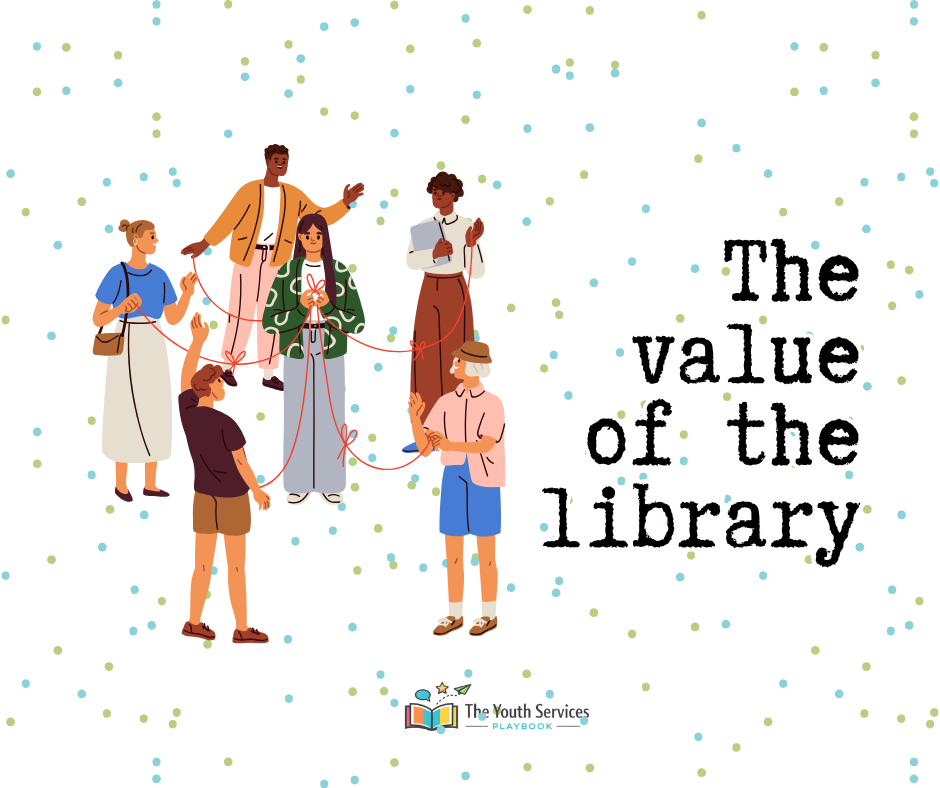
If you’ve followed Youth Services Playbook for any amount of time, you already know this may sound strange coming from me:
I love programs.
Programs are my bread and butter.
The last one I posted, Edible Sand Art, went viral.
I love developing them, marketing them, finding partners, experimenting with new ideas, and creating experiences families remembered. Some of the most joyful moments of my career happened during programs.
Programs matter.
They bring people through the doors. They introduce people to services. They create memories.
But over the last few months, seeing post after post about summer reading events, I’ve found myself thinking more and more about something that doesn’t always show up in annual reports or social media posts:
What happens in the library when there isn’t a program happening?
Because if libraries become places that only exist when entertainment is scheduled, I think we’ve missed something important.
It’s something I’ve thought about a lot lately as libraries put increasing energy into program attendance, Summer Reading numbers, and event calendars.
But what if someone isn’t participating in Summer Reading?
What if they don’t attend programs?
What if what they need from the library has nothing to do with an event at all?
Libraries have always been—and should continue to be—so much more than that.
Libraries Are More Than Books. They Are More Than Events.
When people talk about library value, the conversation often seems to swing between two extremes.
Either libraries are reduced to books.
Or libraries are reduced to programming.
Books matter. Reading matters. Information matters. Those things are foundational and always will be. But books themselves have never been the entire story. Libraries have always been places of access.
Access to information.
Access to technology.
Access to opportunity.
Access to people.
Access to experiences.
Access to belonging.
Some of that happens through collections. Some through services. Some through events. But some of the most important library work happens quietly.
A caregiver discovering resources they didn’t know existed.
A teenager finding a place to spend an afternoon.
Someone applying for jobs.
Someone sitting in air conditioning because they need a break (or a kid asking for a freezer-pop because they knew I always had a stash).
Those moments rarely show up in statistics, but they matter.
Libraries Are Third Spaces
There’s a term I come back to often: third space.
Sociologist Ray Oldenburg popularized the concept in his book The Great Good Place, describing third places as the spaces that exist outside of home (our first space) and work or school (our second space). They are the places people choose to spend time because they feel welcome there—informal, accessible spaces where relationships form, community develops, and people experience connection outside of obligation.
When I first learned about the idea of third spaces in graduate school, it immediately clicked with what I had observed in libraries for years.
Because while libraries provide books, technology, research support, and programs, so much of the meaningful work happening inside them isn’t tied to any one service at all.
It happens in the spaces in between.
It happens when a caregiver stays after storytime and ends up talking with another parent for half an hour while their children play.
It happens when teens come in after school and gather around a table making bracelets, doing homework, coloring, talking, or simply sitting together in a space that feels comfortable.
It happens when someone arrives intending to print a single document and ends up staying because the environment feels calmer than wherever they came from.
It happens when people realize nobody expects anything from them once they walk through the door.
That’s what makes libraries different.
Third spaces have become increasingly difficult to find.
Many places that once served as community gathering spaces now require purchases to participate. Coffee shops expect turnover. Entertainment spaces require tickets. Recreation often comes with membership fees. Even places designed for connection can sometimes feel transactional.
Libraries remain one of the few places left where people can simply show up.
You don’t need to buy anything.
You don’t need a reservation.
You don’t need to justify being there.
You don’t have to prove productivity.
You don’t even need a library card.
You can walk in and stay, and that feels increasingly rare.
Library professionals and researchers have written for years about libraries functioning not only as information centers, but also as places that foster belonging, conversation, creativity, civic engagement, and community life. Libraries create opportunities for people to encounter one another naturally and build relationships in ways that are increasingly difficult to replicate elsewhere. And I think that distinction matters more than we sometimes realize.
Because not everyone has a comfortable home environment, disposable income, or a place where they feel welcome.
Not everyone wants organized entertainment all the time.
Sometimes people just need somewhere to go. Somewhere safe. Somewhere neutral.
Somewhere where existing is enough.
That kind of value doesn’t always show up in circulation numbers or attendance reports, but it absolutely shows up in community impact.
In a time when people talk openly about loneliness, burnout, and feeling disconnected from one another, I think libraries quietly provide something increasingly valuable: a place to belong without having to earn it.
Programs matter.
Books matter.
But so do the moments in between.
That’s not extra library work. That is library work.
Libraries Are Information Centers Too
One of the things I think people forget is that libraries are still one of the most accessible information resources available to the public.
Libraries provide access to databases, internet service, computers, printing, workforce support, educational tools, local information, research assistance, and staff expertise (thank you, MLIS!).
That work may not always create exciting photos for social media, but it changes lives.
Not everyone has reliable internet or owns a computer.
Not everyone knows where to start.
Libraries fill those gaps every day.
Sometimes that looks like helping someone apply for jobs.
Sometimes it means helping a student finish research.
Sometimes it means helping someone navigate technology that everyone else assumes they already know.
Quiet work is still important work.
My Favorite “Program” Wasn’t Actually a Program
One of my favorite things I ever created wasn’t an event.
It was a play space.
I intentionally designed an area where families could gather even when nothing was happening. It was a small corner due to limited space, but we all work with what we have.
Children played while caregivers talked. Parents exchanged stories and recommendations.
And something really beautiful happened.
Families started building their own community.
The success of that space had very little to do with me. It wasn’t successful because I entertained people. It was successful because I created room for people to connect with each other.
That experience completely changed how I thought about library service.
Sometimes our role isn’t creating the experience. Sometimes our role is creating the conditions that allow people to create it themselves.
(You can read more about that space here & here)
I approached our teen area the same way.
I never wanted it to feel like a place people passed through.
I wanted teens to feel invited to stay.
There was usually something available—bracelet supplies, origami, coloring pages, passive activities, puzzles.
Sometimes teens participated. Sometimes they sat quietly.
Sometimes they talked. Sometimes they did absolutely nothing.
And that was okay.
Because teens deserve places to exist too.
If People Don’t Know It Exists, They Can’t Use It
There’s another piece of this conversation I think libraries sometimes overlook:
People cannot value services they don’t know exist.
One of the most surprising things I learned in libraries was how many people had either never visited their local library—or hadn’t been inside for years.
And when they finally came in, many were shocked.
They expected rows of books.
Silence.
Rules.
Shushing.
What they found instead were play spaces, technology, passive activities, libraries of things, and staff who genuinely wanted to help.
Again and again I heard:
“I had no idea the library offered this.”
Libraries have evolved.
Public understanding hasn’t always evolved with them.
This is why marketing matters.
(Read some library marketing tips here and how to write a great newsletter to market your space here)
And I don’t just mean promoting programs.
Programs are easy to advertise because they create a moment in time.
But if programming becomes the only thing we showcase, communities may begin to believe programming is the library.
Show people what happens between events.
Show the caregiver meeting a friend.
Show the teen finding a place to belong.
Show the person applying for jobs.
Show the quiet corners.
Show the databases.
Show the meeting rooms.
Show the spaces people inhabit every day.
Libraries should not be the community’s best-kept secret.
Not Everything Valuable Fits on a Calendar or Report
Libraries are increasingly asked to prove their value through numbers. (End-of-year reports, am I right? Blah!)
- Attendance.
- Circulation.
- Door counts.
- Program statistics.
Those things matter, but they don’t tell the whole story.
How do you measure:
- The caregiver who finally made a friend?
- The teen who stayed because they felt safe?
- The family who returned because they felt welcome?
- The person who needed internet?
- The child who found confidence?
Programs matter.
I will probably always believe in programming.
But programming alone is not a library.
Libraries are ecosystems.
Information centers.
Technology hubs.
Community gathering places.
Safe spaces.
Creative spaces.
Quiet spaces.
Research spaces.
Connection spaces.
And maybe most importantly—
they are places where people can simply be.
That’s library work too.
What does your library offer beyond books and programs?
If you enjoyed this post and want to see others like it, check out these popular posts & subscribe to get the newest posts delivered to your inbox!
*This blog is intentionally ad-free. I want it to be a clean, distraction-free space. Here, public librarians can find practical ideas for youth services, outreach, and programming. There will be no pop-ups or sponsored clutter.
Some posts may include affiliate links for books or supplies I genuinely use and recommend. If you choose to purchase through those links, I may earn a small commission at no additional cost to you. It’s a simple way to support the work while getting materials for your own programs.
If you’ve found value in these ideas, please consider helping keep the blog running. I’m unemployed, so tips are always appreciated. They go directly toward hosting costs and content creation. You can do so here: https://www.paypal.com/ncp/payment/SPBXH4RPDHCCY


Leave a Reply