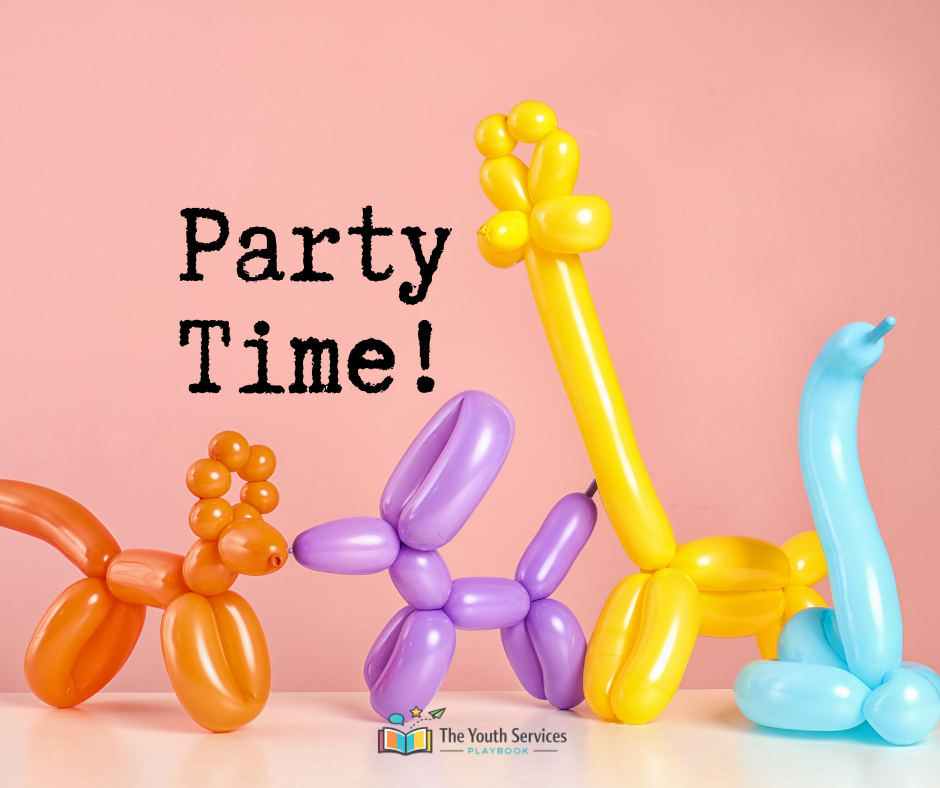
If you had told me a few years ago that I would be hosting a balloon twisting workshop at the library, I would have laughed. I had zero experience. I couldn’t make a balloon dog. I had never even tried.
And that’s exactly why this program worked.
Balloon twisting workshops are the perfect example of how libraries don’t have to be full of experts to be full of learning.
This program isn’t about perfection—it’s about discovery, creativity, and empowering families with skills they can take home with them.
You Don’t Need to Be an Expert
Let me say this first: you do not need any balloon-twisting skills to host this program.
This workshop is about learning together.
Position yourself not as the instructor, but as the facilitator. You’re simply creating the space, providing the tools, and encouraging exploration.
Families learn alongside each other. Kids teach parents. Parents teach kids. Everyone laughs when balloons pop. Everyone celebrates when something actually resembles a dog.
And trust me—that moment always comes.
Simple Supplies Make It Possible
This is a low-cost program with high engagement. All you need are a few basic supplies:
- Balloon twisting balloons – https://amzn.to/46tIeNP
- Manual hand pumps – https://amzn.to/4rBsEIl
- Printed instruction sheets (dogs, swords, flowers, etc.) Below are some resources I found online:
Manual pumps are especially important because they make the program accessible to everyone. Blowing up twisting balloons by mouth is difficult and frustrating—pumps remove that barrier immediately. I will say that I did a lot of knotting for the younger children, but that was to be expected.
Setup: Keep It Simple and Self-Directed
One of the best parts of this program is how easy it is to set up—and how little direct instruction it actually requires.
Before the program started, I pre-inflated about 40 balloons. This allowed participants to immediately start twisting as soon as they walked in, which helped break the ice and made the room feel active and welcoming.
In addition to the pre-inflated balloons, I also provided:
- Plenty of deflated balloons
- Several manual hand pumps
- Printed instruction sheets
I arranged all supplies on a single table so attendees could help themselves throughout the program.
This created a natural flow. Families could grab what they needed, sit together, experiment, and return for more supplies as their confidence grew.
This was a very hands-off program for me. I wasn’t standing at the front teaching. Instead, I was part of the experience—laughing, twisting, and learning alongside everyone else (this is why I have no photos of the event!)
That shared participation helped create a relaxed environment where people felt comfortable trying something new.
Learn One or Two Simple Designs Ahead of Time
While you don’t need to be an expert, I do recommend teaching yourself one or two simple creations beforehand.
I learned how to make:
- A simple sword
- A basic dog
Having a few ready-made balloon sculptures served as inspiration for kids and helped build excitement as they arrived.
It also gave me the confidence to help if someone needed it.
But perfection isn’t the goal. Kids don’t care if the dog is a little crooked.
They care that it was made for them.
Schedule It for Families
I hosted this program on a Saturday afternoon, and it was the perfect timing. Families were relaxed, unhurried, and ready to spend time together. And honestly, I think the parents had more fun than the kids.
They were laughing, helping each other, and proudly showing off their creations.
Several parents told me they planned to use their new skills for future birthday parties.
That’s when I realized how meaningful this program really was.
You’re Giving Families Real-Life Skills
This program isn’t just fun—it’s practical.
You’re giving parents and caregivers:
- A free skill they can use at home
- Tools to create memorable birthday parties
- Confidence to try something new
- Opportunities for creative play with their children
For many families, hiring entertainment isn’t financially possible.
But learning to do it themselves?
That’s empowering.
Libraries Provide Education Beyond Books
Programs like this reflect something bigger about what libraries truly are.
The American Library Association describes libraries as centers of lifelong learning—and that learning doesn’t only happen through books.
It happens through:
- Creating
- Experimenting
- Playing
- Trying something new
Libraries provide hands-on education, not just informational education.
We help people gain skills, confidence, and creativity.
Final Thoughts
You don’t need special skills to host meaningful programs.
You just need to create the opportunity.
Balloon twisting workshops are low-cost, low-pressure, and high-impact. They empower families, encourage creativity, and demonstrate that learning at the library can take many forms.
Sometimes, all it takes is a balloon.
If you enjoyed this post and want to see others like it, check out these popular posts & subscribe to get the next one delivered to your inbox!
*This blog is intentionally ad-free. I want it to be a clean, distraction-free space. Here, public librarians can find practical ideas for youth services, outreach, and programming. There will be no pop-ups or sponsored clutter.
Some posts may include affiliate links for books or supplies I genuinely use and recommend. If you choose to purchase through those links, I may earn a small commission at no additional cost to you. It’s a simple way to support the work while getting materials for your own programs.
If you’ve found value in these ideas, please consider helping keep the blog running. Tips are always appreciated. They go directly toward hosting costs and content creation. You can do so here: https://www.paypal.com/ncp/payment/SPBXH4RPDHCCY

Leave a Reply